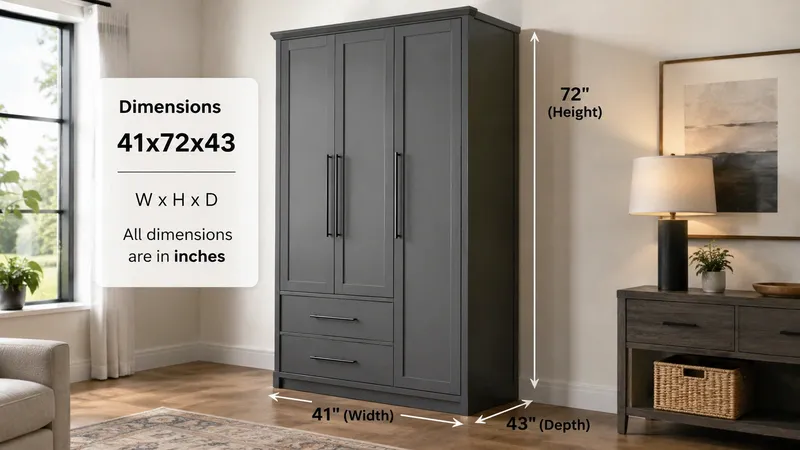
Search for 41x72x43, and you’ll find plenty of pages guessing at what it means — some call it a sofa wedge, others a storage locker, others a water heater. The honest answer is simpler and more useful: 41x72x43 isn’t a fixed, standardized size tied to one product category. It’s a three-number dimension format that shows up across furniture, appliances, shipping, and storage, and what it actually describes depends entirely on the unit of measurement and the item it’s attached to.
This guide explains how to read a dimension code like 41x72x43 correctly, why the same three numbers can mean wildly different things, and how to confirm exactly what you’re looking at before you buy or build around it.
What the Numbers Actually Mean
A measurement like 41x72x43 is shorthand for three physical measurements of an object, usually written in one of two orders:
- Length × Width × Height (L × W × H) — common in shipping and general retail
- Width × Depth × Height (W × D × H) — common in furniture and cabinetry
Neither order is universal. A furniture listing and a shipping label can both use 41x72x43 and mean something completely different, because the industries don’t agree on which number comes first. That’s the first thing to check on any listing: does the seller specify the order, or just throw out three numbers?
Why the Unit of Measurement Changes Everything
This is the part most guides skip, and it’s the most important detail in the entire dimension. Without a unit, 41x72x43 tells you almost nothing.
- In inches, 41x72x43 describes something roughly 3.4 feet wide, 6 feet tall, and 3.6 feet deep — large enough to be a sectional sofa piece, a full-size wardrobe, or a tall storage cabinet.
- In centimeters, the same numbers describe something closer to 16 inches wide, 28 inches tall, and 17 inches deep — a much smaller item, like a mini fridge, a filing cabinet, or a compact locker.
That’s roughly a six-fold difference in size depending on which unit the seller used. I’ve seen buyers order what they assumed was a small storage bin, only to receive a full-height cabinet, simply because the listing dropped the unit and they guessed wrong. Always confirm inches versus centimeters before you measure your space or place an order.
Quick Conversion Reference
If you know the unit and need to convert:
- 41x72x43 inches ≈ 104 × 183 × 109 centimeters
- 41x72x43 centimeters ≈ 16 × 28 × 17 inches
Keep in mind these are approximate conversions (1 inch = 2.54 cm), useful for comparing listings across countries that use different measurement standards.
Where You’re Likely to See This Dimension Format
Rather than claiming 41x72x43 belongs to one specific product, it’s more accurate to say this general size range shows up in a few common categories, depending on the unit:
At larger (inch) scale, dimensions in this range commonly appear on modular furniture pieces, tall storage cabinets, and wardrobe units — items built to stand upright and hold significant volume.
At smaller (centimeter) scale, similar numbers turn up on compact appliances, office storage cabinets, and utility lockers designed to fit into tight spaces like closets, mudrooms, or garages.
In both cases, the number sequence itself isn’t proof of a specific product. It’s a size range that happens to fit several categories, which is exactly why confirming the source listing matters more than the numbers alone.
How to Check Fit Before You Buy
A dimension code only helps if it’s checked against your actual space. A simple process avoids costly returns:
- Confirm the unit (inches or centimeters) directly with the seller if it isn’t listed.
- Confirm the order (is the first number width, length, or something else?).
- Measure your intended space in the same unit, including doorways or hallways the item needs to pass through.
- Add a few inches of buffer for clearance, especially for anything that opens, like cabinet or locker doors.
Skipping step three is the most common mistake. A product can technically fit a room’s floor space and still be impossible to maneuver through a narrow doorway or stairwell.
Conclusion
41x72x43 isn’t a single, fixed product size — it’s a dimension pattern that can describe very different objects depending on the unit and the order the numbers are listed in. The safest approach with any listing that uses this format is to treat the numbers as a starting point, not a final answer, and confirm the unit and orientation directly before you measure, buy, or build around it.
When in doubt, ask the seller for the exact unit and orientation in writing. It takes thirty seconds and prevents the kind of mismatch that turns into a frustrating return. For more information, visit our website.